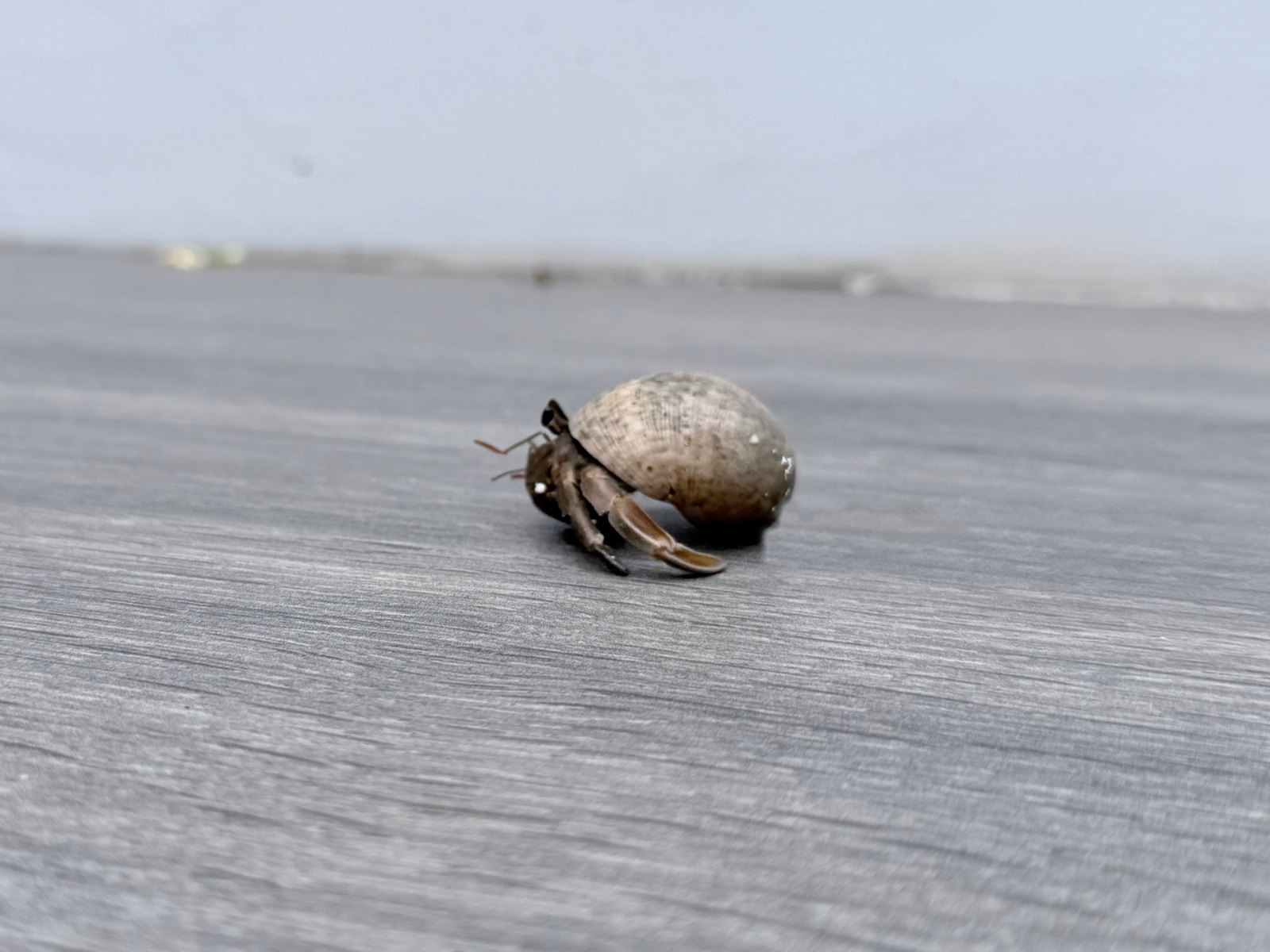
The hermit crabs people keep at home are land hermit crabs. Their Latin name starts with Coenobita (say it roughly like "see-noh-BYE-tuh"). That's the scientific group name, and there are around 20 different kinds inside it. One of the best known is Coenobita clypeatus, nicknamed the "purple pincher" because of its purple claw.
Most kinds of Coenobita live around the Indian and Pacific Oceans, and that includes the beaches of Indonesia. So these little guys are practically our neighbours.
1. They aren't true crabs
Even with "crab" in the name, hermit crabs belong to a different group from normal crabs. Their relatives include king crabs and squat lobsters.
2. Their home is borrowed
A hermit crab's back half is soft, so it moves into an empty snail shell to protect itself. It also keeps a little water inside the shell, which helps it stay damp while it walks around on land.
3. They line up to swap shells
When a new, bigger shell shows up, hermit crabs sometimes gather and line up from biggest to smallest. When the biggest crab moves in, the next one takes its old shell, and so on down the line. Everyone gets an upgrade.
It isn't always that polite, though. They can also fight over a shell they like, and the loser can get hurt.
4. One giant claw
Many land hermit crabs have a left claw that's much bigger than the right one. When the crab pulls back into its shell, that big claw blocks the opening like a door.
5. They can "talk"
Some land hermit crabs make little chirping sounds, especially when they're stressed or arguing.
6. They start life in the sea
Land hermit crabs need the ocean to have babies. The mother carries her eggs, then walks to the sea to release them. The babies float in the water as tiny larvae before they come onto land and find their very first shell.
7. Their giant cousin
The coconut crab is a close relative of hermit crabs. It uses shells when it's young, but the adults grow a hard body of their own and become the biggest land invertebrate in the world (an invertebrate is an animal without a backbone).
Want to look after one?
If you'd like to know how to care for hermit crabs at home, read my Care Notes. And if you want one of your own, send me an order slip at the bottom of this page.